Introduction
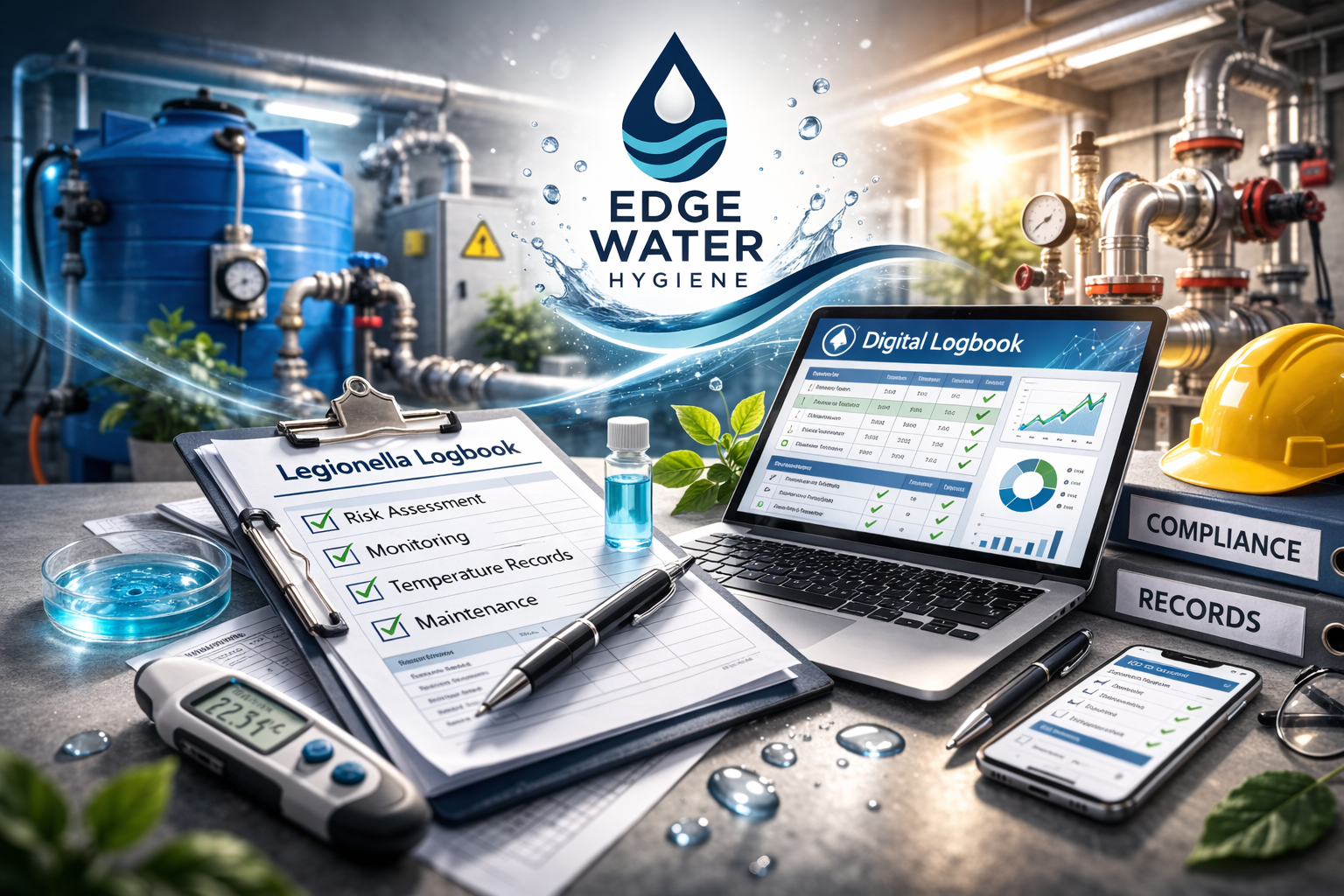
If you are responsible for managing a building’s water system, you must not only control the risk of Legionella — you must be able to demonstrate that control. Demonstration means documentation. If monitoring is not recorded properly, it cannot be proven.
Legal Requirements
Under the Health and Safety at Work Act and the Control of Substances Hazardous to Health (COSHH) Regulations, duty holders are required to assess risk, implement control measures, monitor those measures, and retain appropriate records. ACoP L8 and HSG274 make clear that structured record keeping is a fundamental part of compliance.
Core Records Required
Most commercial and public buildings should maintain records covering:
- Risk assessment details
- Responsible person allocation
- Written scheme of control
- Temperature monitoring
- Cold water storage tank inspections
- Shower flushing regimes
- TMV servicing (where applicable)
- Remedial action tracking
- Evidence of periodic review
These records collectively demonstrate that the system is being actively managed.
Temperature Monitoring Records
Temperature monitoring typically includes:
- Monthly sentinel hot water temperatures
- Monthly sentinel cold water temperatures
- Calorifier flow and return temperatures
- Incoming mains temperature where required
Missing or inconsistent temperature records are among the most common compliance failings identified during audits.
Tank Inspection Records
Cold water storage tank inspections should record:
- Tank condition
- Cleanliness
- Water temperature
- Lid and insulation integrity
- Any contamination risks
- Required remedial actions
These inspections demonstrate that stored water remains protected from contamination and temperature risk.
Flushing and TMV Records
Where outlets are infrequently used, flushing regimes must be documented clearly, including dates and responsible persons.
If thermostatic mixing valves (TMVs) are installed, servicing and fail-safe testing should also be recorded, particularly in healthcare, care, and education settings.
Remedial Action Log
Any issues identified during monitoring or inspection must be recorded alongside:
- The action required
- Who is responsible
- Completion date
- Confirmation that the issue has been resolved
This shows active management rather than passive monitoring.
Why Structure Matters
Compliance failures rarely occur because monitoring is not being carried out. More commonly, they occur because records are inconsistent, scattered across systems, or incomplete.
A structured compliance system ensures:
- Clear responsibility
- Consistent documentation
- Easy review
- Audit readiness
Structure is what makes documentation defensible.
Inside the Edge Water Hygiene Digital Compliance Logbook
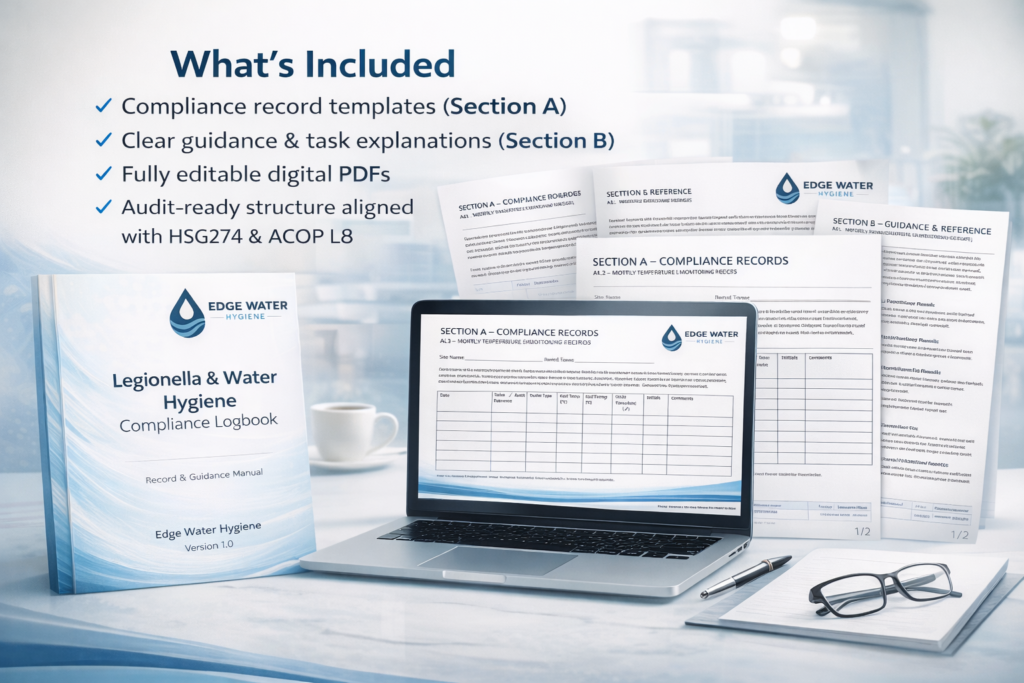
The digital compliance logbook is divided into two structured sections:
Section A – Management & Control
Establishes responsible persons, risk assessment references, written scheme alignment, and monitoring schedules.
Section B – Monitoring & Record Keeping
Provides structured record sheets for temperature monitoring, tank inspections, flushing regimes, TMV servicing, remedial actions, and system reviews.
Built for Non-Technical Responsible Persons
Developed by an experienced water hygiene professional, the logbook is designed for facilities managers, responsible persons, managing agents, and small to medium organisations.
It provides a clear, structured system without requiring specialist engineering knowledge.
Conclusion
Effective Legionella compliance requires consistent monitoring supported by structured, defensible records.
A digital compliance logbook provides a practical, organised framework to demonstrate control and maintain audit readiness.
To implement a ready-built structured compliance solution, view the Edge Water Hygiene Digital Compliance Logbook.
Leave a Reply