
Introduction
Setting up a Legionella logbook is not about creating paperwork for the sake of it. It is about creating a structured system that demonstrates control of your water systems. When built correctly, a digital logbook becomes the backbone of compliance.
Step 1 – Define Responsibility Clearly
Identify the duty holder and responsible person. Record who carries out monitoring, who reviews records, and who authorises remedial actions. Without defined responsibility, compliance becomes inconsistent.
Step 2 – Reference the Risk Assessment
Your logbook must align with your current Legionella risk assessment. Document the assessment date, review date, key findings, and required control measures.
Step 3 – Align with the Written Scheme of Control
The written scheme outlines how the system is managed. Your digital logbook should mirror this structure, including monitoring frequencies, action limits, and escalation procedures.
Step 4 – Build a Structured Monitoring Schedule
Establish clear monitoring intervals for temperature checks, tank inspections, flushing regimes, and TMV servicing. A digital format allows consistency and avoids missed tasks.
Step 5 – Standardise Record Sheets
Each monitoring activity should use a consistent format. Standardised temperature logs, tank inspection forms, and remedial action records ensure clarity and audit readiness.
Step 6 – Implement a Remedial Action Log
Issues identified during monitoring must be recorded, tracked, and signed off once resolved. This demonstrates active management rather than passive observation.
Step 7 – Review and Maintain
Monitoring records should be reviewed periodically to ensure trends are identified and control measures remain effective. The logbook should also reference risk assessment review dates.
Why Digital Is More Effective Than Informal Systems
Paper folders and disconnected spreadsheets often lead to missing data and inconsistent formats. A structured digital system centralises documentation, improves accountability, and makes audit preparation straightforward.
Inside the Edge Water Hygiene Digital Compliance Logbook
The logbook is divided into:
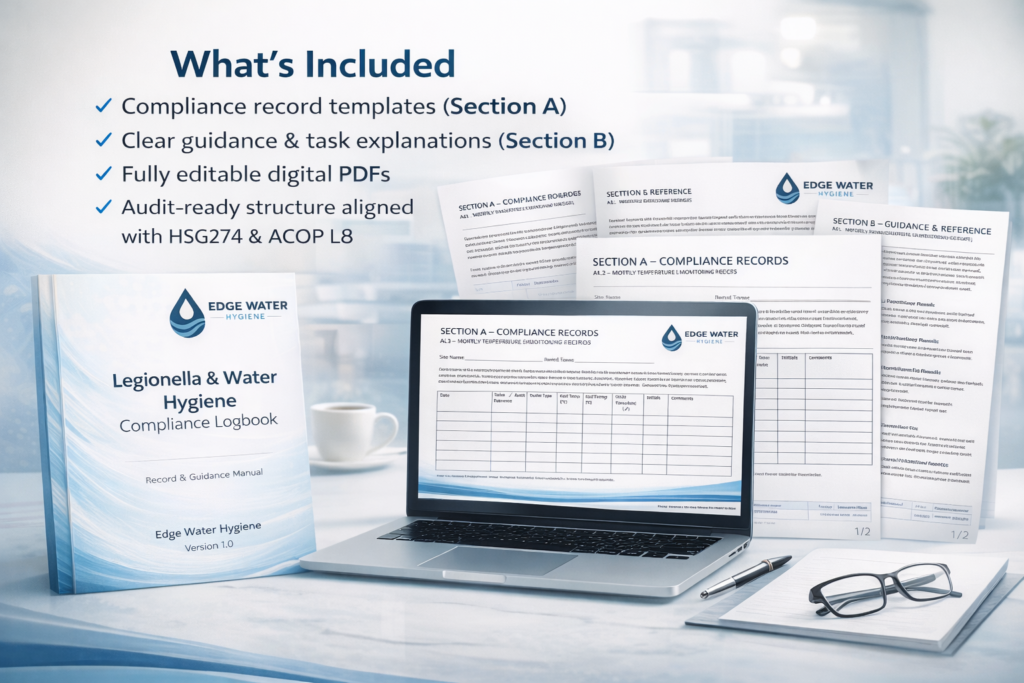
Section A – Management & Control, establishing roles, risk assessment references, written scheme alignment, and monitoring structure; and
Section B – Monitoring & Record Keeping, providing ready-to-use record sheets for temperature monitoring, cold water storage tank inspections, flushing, TMV servicing, remedial actions, and system reviews.
Built for Non-Technical Responsible Persons
Designed by an experienced water hygiene professional, the logbook is structured for facilities managers, responsible persons, managing agents, and organisations without specialist engineering knowledge. The format guides users through consistent and defensible compliance.
Conclusion
A properly structured digital Legionella logbook provides clarity, consistency, and defensible evidence of control. If you would prefer a ready-built system rather than constructing one from scratch, the Edge Water Hygiene Digital Compliance Logbook provides a structured, professional solution.
Leave a Reply