
Introduction
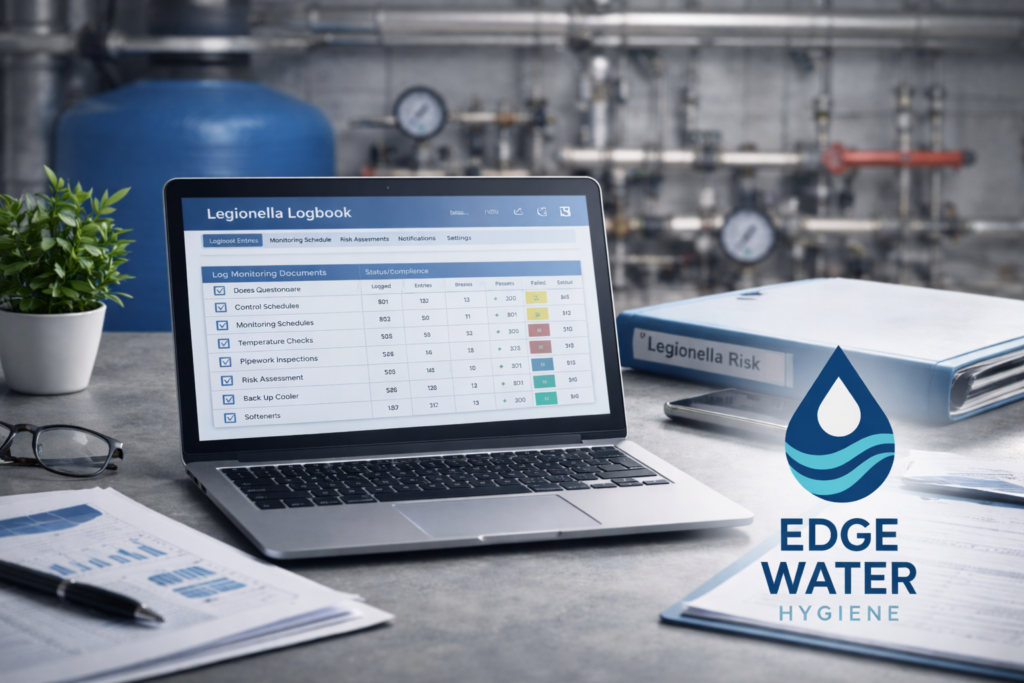
If you are responsible for a building’s water system, you are legally required to assess, manage, and monitor the risk of Legionella. What many duty holders misunderstand is that monitoring alone is not enough. Records must be kept. If it is not documented, it has not been done.
What the Law Requires
Under the Health and Safety at Work Act and COSHH Regulations, duty holders must assess risk, implement control measures, monitor those measures, and retain records. HSE guidance (ACoP L8 and HSG274) makes clear that documentation is a fundamental part of compliance.
Risk Assessment vs Ongoing Compliance
A Legionella risk assessment identifies required control measures. A compliance logbook demonstrates that those measures are being implemented consistently. They are separate but equally essential parts of effective water hygiene management.
Why Businesses Get Into Difficulty
Common failures include missing temperature records, incomplete tank inspections, inconsistent flushing records, and unclear responsibility allocation. Often monitoring is taking place, but without structured documentation, there is no defensible evidence of control.
Why a Structured Digital Logbook Matters
Paper systems and informal spreadsheets are easily lost, inconsistent, and difficult to review. A structured digital compliance logbook centralises documentation, improves accountability, and supports audit readiness.
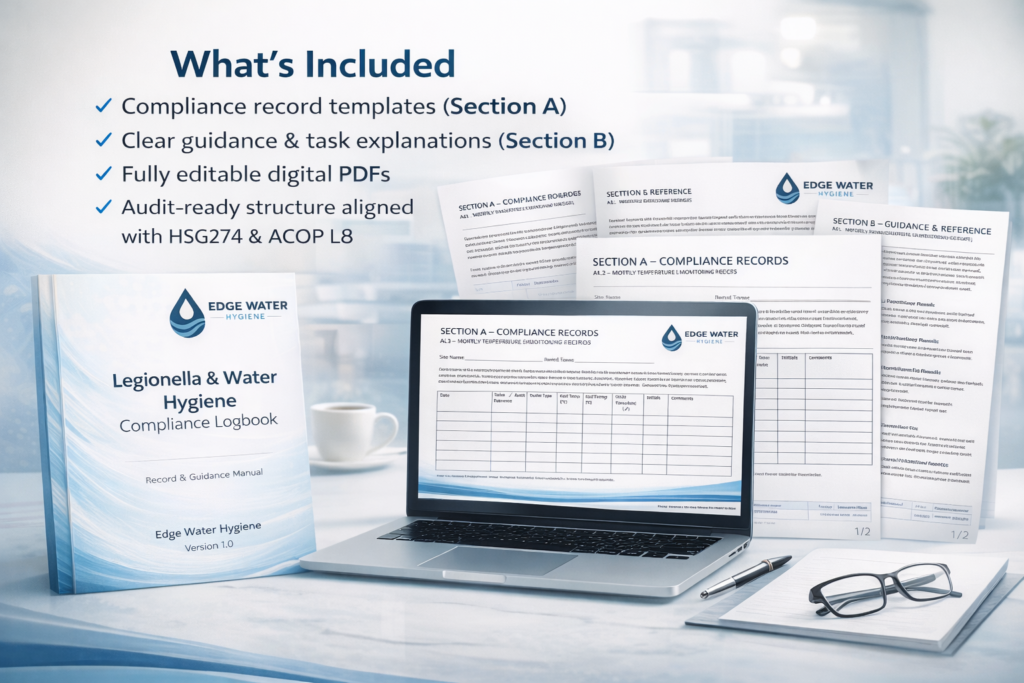
Inside the Edge Water Hygiene Digital Compliance Logbook
The logbook is divided into two clear sections.
Section A – Management & Control establishes responsible persons, roles, risk assessment references, written scheme alignment, and monitoring structure.
Section B – Monitoring & Record Keeping provides ready-to-use record sheets for temperature checks, cold water storage tank inspections, shower flushing, TMV servicing, remedial actions, and system reviews.
Built for Non-Technical Duty Holders
The logbook has been developed by an experienced water hygiene professional and is designed for facilities managers, responsible persons, managing agents, and small to medium organisations. No specialist engineering knowledge is required — the structure guides you through consistent compliance.
Conclusion
If you are responsible for managing a water system, you must demonstrate control through structured, consistent record keeping. A digital compliance logbook provides clarity, accountability, and defensible documentation in one organised system. To implement a ready-built structured solution, view the Edge Water Hygiene Digital Compliance Logbook.
Leave a Reply