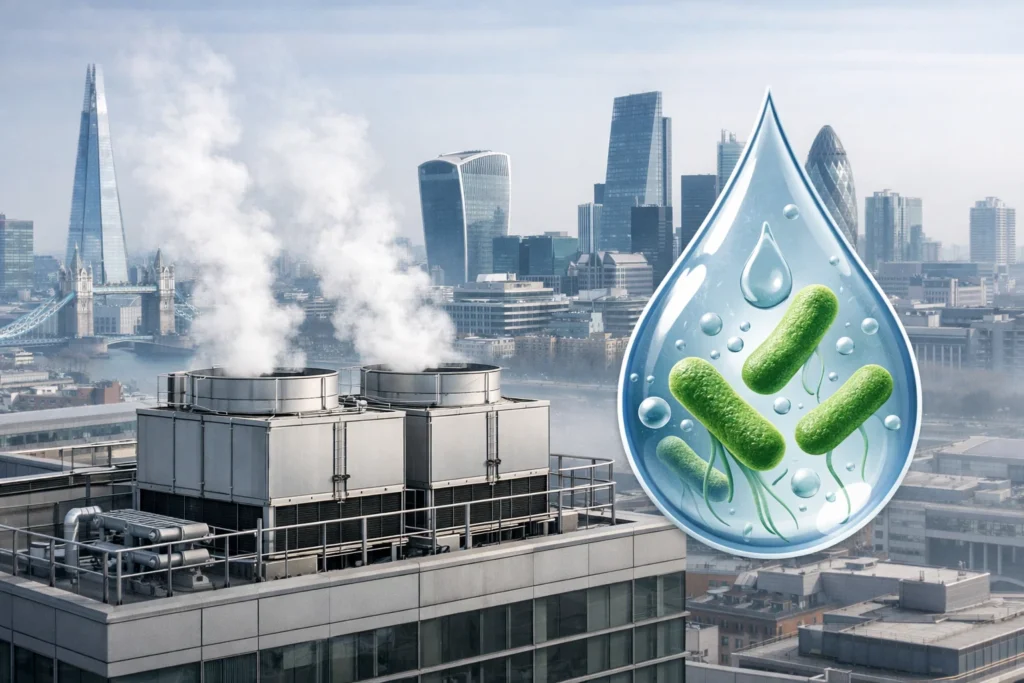
Recent news reports have highlighted an investigation into a cluster of Legionnaires’ disease cases in parts of London, prompting renewed attention on water safety and Legionella control in buildings across the capital.
Health officials from the UK Health Security Agency (UKHSA) are currently investigating several reported cases linked to areas of north-west and south-west London. At present, authorities are working to determine whether the infections share a common source and where the bacteria may have originated.
While the risk to the wider public remains low, the incident highlights an important reminder for building owners, landlords, and facilities managers: poorly managed water systems can present serious health risks if Legionella is allowed to develop.
What Is Legionnaires’ Disease?
Legionnaires’ disease is a severe form of pneumonia caused by Legionella bacteria. People become infected by breathing in tiny droplets of water (aerosols) contaminated with the bacteria.
Common sources can include:
- Showers and taps
- Cooling towers and air conditioning systems
- Spa pools and hot tubs
- Large building water systems
- Decorative fountains
The bacteria occur naturally in water but can multiply rapidly in warm, stagnant conditions, especially in complex plumbing systems or poorly maintained installations.
Symptoms typically appear 2–14 days after exposure and may include:
- Fever and chills
- Dry cough
- Headaches and muscle aches
- Shortness of breath
- Fatigue
Although treatable with antibiotics, Legionnaires’ disease can be serious and often requires hospital treatment.
Why Outbreaks Occur
Legionella bacteria thrive in conditions where water systems are not properly designed, maintained, or monitored.
Risk factors in buildings often include:
- Water stored between 20°C and 45°C
- Stagnant pipework or dead legs
- Poor temperature control
- Infrequently used outlets
- Lack of regular monitoring or maintenance
Large buildings such as hotels, offices, hospitals, and residential blocks are particularly vulnerable due to the complexity of their plumbing systems.
The Legal Responsibility of Duty Holders
Under UK health and safety law, organisations must manage the risk from Legionella.
Key legislation includes:
- Health and Safety at Work etc. Act 1974
- Control of Substances Hazardous to Health Regulations 2002 (COSHH)
- HSE Approved Code of Practice L8 – Legionnaires’ disease: The control of Legionella bacteria in water systems
Duty holders (such as building owners, landlords, and facilities managers) must ensure that:
- A Legionella risk assessment is carried out
- A written scheme of control is in place
- Water systems are regularly monitored and maintained
- Staff responsible for water safety are properly trained
Failure to comply can result in serious legal consequences, including enforcement action or prosecution.
Legionnaires’ disease warning as cases SPIKE in major UK city – The Mirror
Preventing Legionella in Buildings
Effective Legionella control usually involves a combination of measures such as:
✔ Regular Legionella risk assessments
✔ Monitoring hot and cold water temperatures
✔ Flushing rarely used outlets
✔ Maintaining cold water storage tanks and calorifiers
✔ Removing redundant pipework (dead legs)
✔ Routine inspection, cleaning, and disinfection of systems
When properly managed, the risk of Legionella growth can be significantly reduced.
A Reminder for London Building Managers
Although outbreaks are relatively rare, this current investigation demonstrates how quickly Legionella can become a public health concern if water systems are not properly controlled.
With thousands of complex buildings across London — including offices, hotels, healthcare facilities, and residential developments — robust water hygiene management is essential to protect occupants and ensure legal compliance.
How Edge Water Hygiene Can Help
At Edge Water Hygiene, we support organisations across London and the UK with:
- Legionella risk assessments
- Water system monitoring
- Compliance support
- Written schemes of control
- Legionella sampling and analysis
If you are responsible for managing a building’s water systems, ensuring compliance with Legionella control regulations is essential for protecting occupants and meeting your legal obligations.
✔ Need help with Legionella compliance?
Contact Edge Water Hygiene today to discuss your water safety requirements.
Leave a Reply