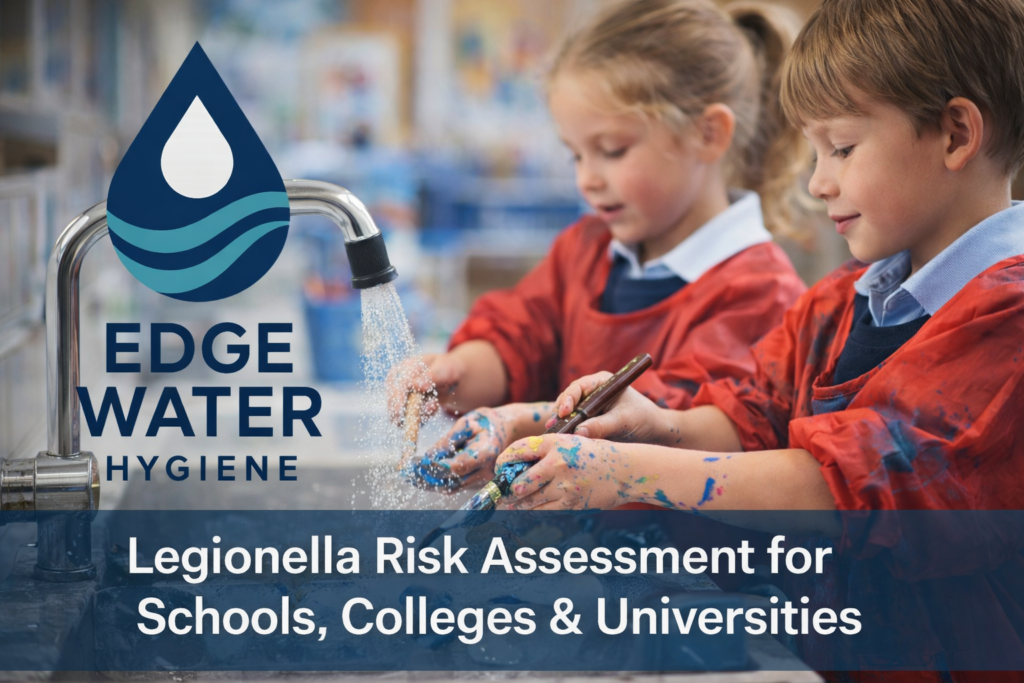
Educational buildings contain a wide variety of water systems, from simple wash basins and staff kitchenettes to complex laboratories, cooling equipment and student accommodation. Because these systems operate under different conditions and usage patterns, effective Legionella control is essential for schools, colleges and universities.
Educational facilities also experience seasonal changes in occupancy, such as school holidays and university term breaks, which can increase the risk of water stagnation. Without proper management, these conditions can allow bacteria such as Legionella to develop in water systems.
A structured Legionella risk assessment and water hygiene management programme helps ensure these risks are properly controlled while keeping organisations compliant with UK health and safety legislation. At Edge Water Hygiene, we support educational organisations across the UK with Legionella risk assessments, water monitoring and compliance guidance to help maintain safe water systems.
Legal Requirements for Legionella Control in Educational Buildings
Schools, colleges and universities have a legal duty to manage Legionella risks in their water systems. Relevant UK legislation includes:
• Health and Safety at Work etc. Act 1974
• Management of Health and Safety at Work Regulations 1999
• Control of Substances Hazardous to Health Regulations 2002 (COSHH)
Compliance is usually achieved by following guidance from the Health and Safety Executive (HSE), particularly:
• ACoP L8 – Legionnaires’ disease: The control of Legionella bacteria in water systems
• HSG274 – Legionnaires’ disease: Technical guidance
These documents outline how duty holders should identify risks, implement control measures and monitor water systems to prevent the growth of Legionella bacteria.
What is Legionnaires’ Disease?
Legionnaires’ disease is a serious form of pneumonia that occurs when people inhale tiny water droplets containing Legionella bacteria. The bacteria naturally occur in freshwater environments such as rivers and lakes. However, they can multiply rapidly in artificial water systems when certain conditions are present.
These conditions include:
• Water temperatures between 20°C and 45°C
• Water being stored or recirculated
• The presence of nutrients such as scale, sludge or rust
• Equipment capable of generating water aerosols
Why Legionella Risk is Higher in Schools and Universities
Seasonal Building Occupancy
Schools and universities often experience extended periods of reduced usage during holidays or refurbishment works. Low water usage can lead to water stagnation, which may encourage bacterial growth. Implementing flushing regimes for little-used outlets helps minimise this risk.
Complex Water Systems in Educational Facilities
Large campuses may include showers, laboratory equipment, cooling systems, emergency safety showers and student accommodation water systems. Each system should be identified and considered as part of a comprehensive Legionella risk assessment.
Vulnerable Building Occupants
Educational settings may contain individuals who are more susceptible to infection, including young children, older staff or visitors, and individuals with underlying health conditions. This makes effective water safety management particularly important.
Key Water Hygiene Control Measures in Schools and Universities
Legionella Risk Assessments
A Legionella risk assessment is a legal requirement for buildings with water systems that could pose a risk. A competent assessor should identify potential sources of Legionella growth, assess aerosol generating equipment, review system design and water storage, and recommend appropriate control measures.
Appointing a Responsible Person
Duty holders should appoint a Responsible Person to oversee water safety management. Responsibilities include implementing control measures, coordinating maintenance activities, maintaining records and liaising with specialist contractors.
Maintenance of Water Systems
• Maintaining hot water cylinders at approximately 60°C
• Ensuring cold water remains below 20°C
• Inspecting and cleaning cold water storage tanks
• Removing redundant pipework or unused outlets
• Flushing little-used outlets weekly
• Including thermostatic mixing valves within maintenance schedules
• Checking expansion vessels and standby equipment
Monitoring Water Systems for Legionella Control
• Monthly temperature checks at sentinel outlets
• Inspection of pipework and fittings
• Routine testing of thermostatic mixing valves
• Visual inspection of water storage tanks
• Maintaining system schematics and asset registers
Creating a Legionella Written Scheme of Control
The information gathered during the risk assessment process should be used to develop a Written Scheme of Control. This document outlines how the water system will be managed and should include control measures, monitoring procedures, maintenance schedules and clearly defined responsibilities.
Professional Legionella Risk Assessments for Schools and Universities Managing water hygiene across educational estates can be challenging due to the scale and complexity of water systems. At Edge Water Hygiene we provide Legionella risk assessments, water hygiene monitoring programmes, compliance audits and consultancy to help organisations maintain safe and compliant water systems.
Leave a Reply