
How little-used outlets and stagnant water quietly create problems in buildings
Walk around almost any building and you’ll find them.
The shower in a changing room nobody uses anymore. The sink in a meeting room kitchen staff forgot existed. The tap in a spare office, an unused hotel room, or a healthcare room waiting for occupancy.
They sit there quietly for weeks or months with no obvious signs of a problem.
But in water hygiene, these forgotten outlets can create one of the most common Legionella risks found during site assessments: stagnation.
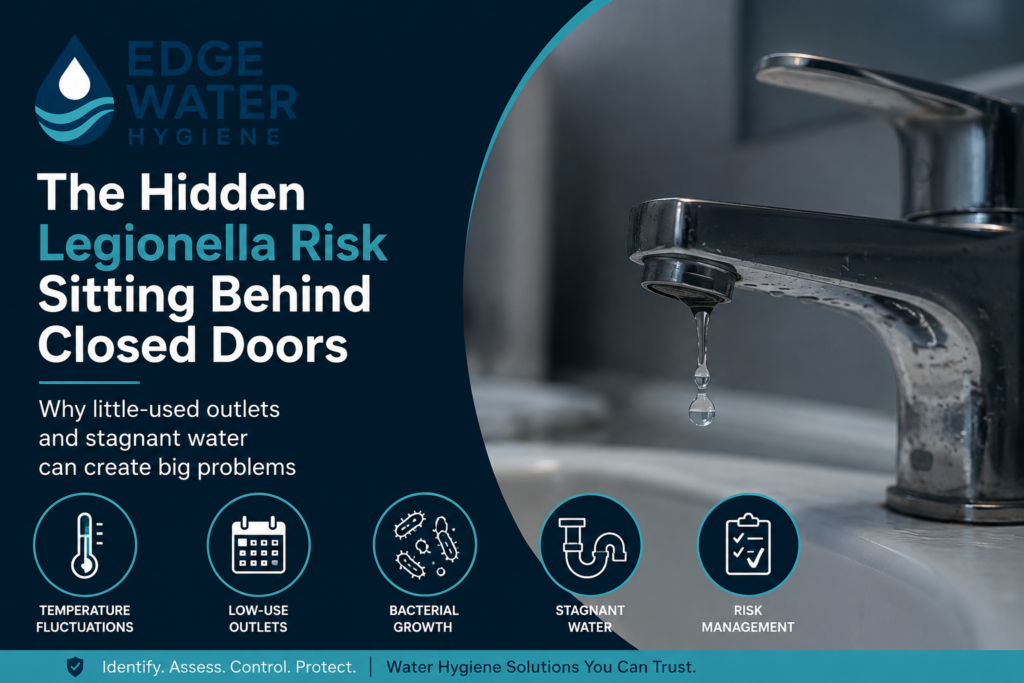
Why stagnant water matters
Water systems are designed with movement in mind.
When water regularly moves through pipework, temperatures remain more stable, disinfectant residuals are maintained, and the system is less likely to develop conditions that encourage bacterial growth.
When water remains still for extended periods:
- Water temperatures can drift into the 20°C–45°C range
- Disinfectant levels may reduce
- Biofilm can develop inside pipework
- Sediment and scale can build up
- Bacteria, including Legionella, may have more favourable conditions to multiply
The risk is often not the unused outlet itself.
The risk is what happens when somebody suddenly turns it on after weeks or months of inactivity.
Sites where we commonly find low-use outlets
Low-use outlets appear almost everywhere:
- Offices with hybrid working arrangements
- Hotels with unoccupied rooms
- Schools during holiday periods
- Healthcare environments
- Vacant commercial properties
- Residential buildings with unused flats
- Seasonal facilities
Over time, usage patterns change but water systems often remain exactly as they were originally designed.
A building that once had 100% occupancy might now only use a fraction of its outlets regularly.
Why “out of sight, out of mind” becomes a problem
One of the biggest issues isn’t the outlet itself.
It’s documentation.
During assessments we sometimes find:
- No flushing records
- No identified low-use outlet register
- Dead legs still connected to systems
- Staff unaware that outlets have become rarely used
- Historical alterations not reflected in schematics
Without identifying these areas, risk management becomes reactive rather than preventative.
Practical control measures
Managing low-use outlets doesn’t always mean major system alterations.
Simple control measures can include:
✔ Identifying and recording low-use outlets
✔ Routine flushing programmes
✔ Removing redundant pipework where possible
✔ Reviewing building occupancy changes
✔ Updating written schemes and monitoring procedures
✔ Assessing whether outlets remain necessary
The right solution depends on how the building is used and the overall system design.
Small issue, bigger consequences
Many of the most significant findings during Legionella risk assessments don’t come from dramatic failures or obvious defects.
They come from small changes over time:
A room becomes storage space.
An office becomes vacant.
A shower stops being used.
Then months later, nobody remembers it’s there.
That’s why understanding how a building actually operates today is just as important as understanding how it was designed years ago.
Need support with Legionella risk management?
Whether you’re managing offices, healthcare facilities, hotels, education buildings or commercial properties, regular review of water systems helps identify risks before they become larger problems.
Leave a Reply